
Blockchain Development Trends to Watch in 2026
From account abstraction to ZK-rollups and modular chains — here are the blockchain development trends reshaping how we build decentralised applications in 2026.
Adnan Akhtar
CEO & Founder
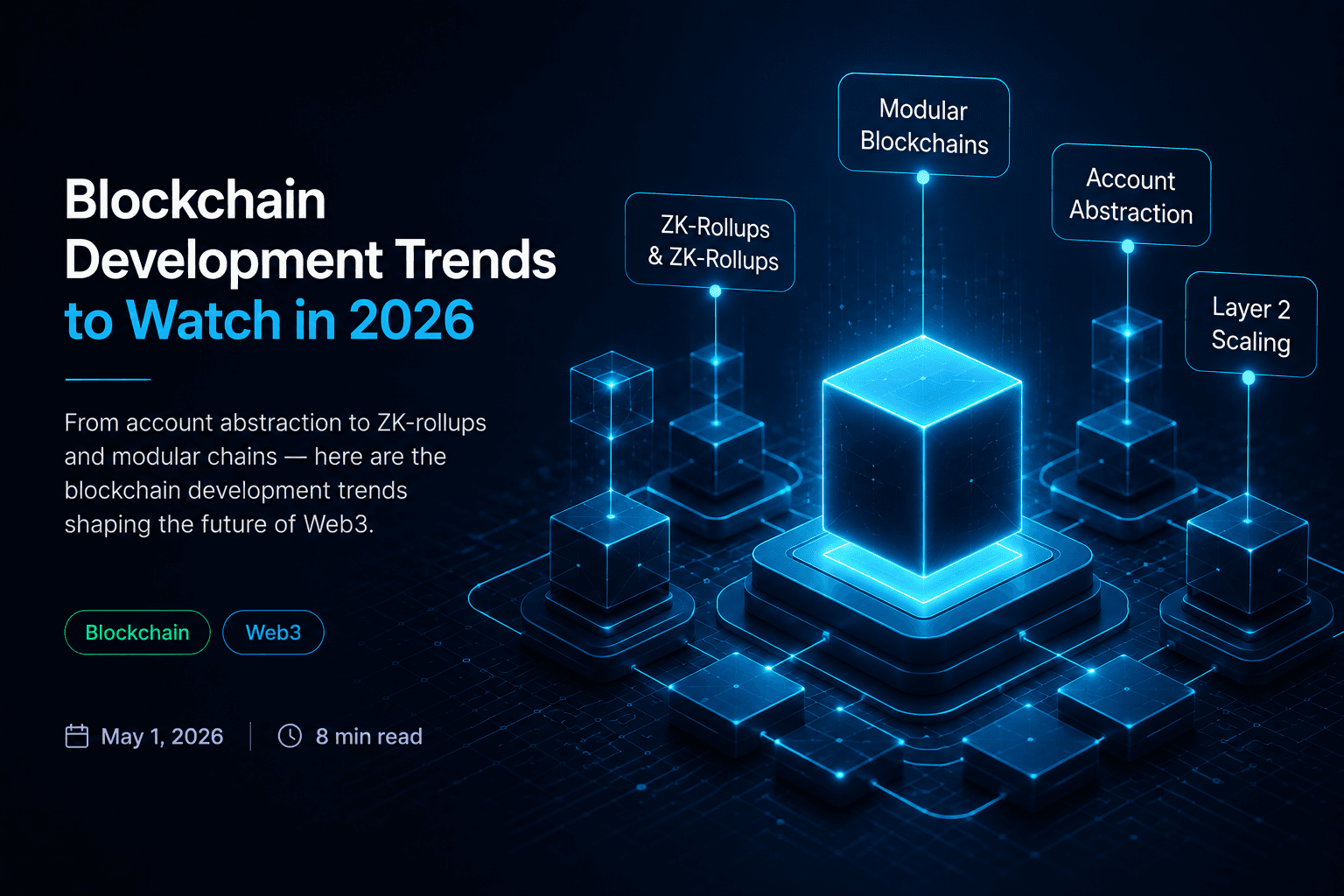
The blockchain development trends shaping 2026 are some of the most consequential since Ethereum launched smart contracts. At Legereum, we work across DeFi protocols, smart contracts, and Web3 applications every day — and the patterns we're seeing in production are clear signals of where the industry is heading.
Whether you're planning your first blockchain product or scaling an existing protocol, these are the trends that will determine your architectural decisions in the next 12–18 months.
1. Account Abstraction Is Redefining the User Experience
EIP-4337 turned account abstraction from a whitepaper concept into a production-ready standard, and the adoption numbers in 2026 are compelling. Smart accounts have crossed 10 million deployments on Ethereum mainnet and its L2s combined.
What this unlocks in practice:
- Gasless transactions: applications can sponsor gas fees, removing the biggest onboarding barrier for non-crypto users (no need to hold ETH just to use a dApp)
- Social recovery: wallets can be recovered via trusted contacts instead of a seed phrase — eliminating the single biggest source of permanent fund loss
- Session keys: users approve a time-limited session once, then interact with a dApp without approving every transaction
- Batched transactions: combine multiple operations (approve + swap + stake) into a single atomic transaction
- Multi-factor authentication: add a second device or biometric check to high-value transactions natively at the wallet level
If you're building any consumer-facing Web3 product in 2026 and not implementing account abstraction from day one, you're accepting an avoidable UX penalty that will hurt retention. Retrofitting AA later is expensive; designing for it from the start is not.
Key infrastructure: Pimlico (paymaster + bundler), Alchemy Account Kit, ZeroDev, and Safe's smart account SDK are the leading AA stacks for builders.
2. ZK-Rollups Are the Default for New Protocol Development
Optimistic rollups (Arbitrum, Optimism, Base) dominated 2022–2024 because the tooling was simpler and the EVM compatibility was more complete. But two fundamental limitations have become harder to ignore:
- The 7-day challenge period for withdrawals back to L1 — a painful UX problem for any application requiring fast finality
- The economic model increasingly favours ZK as proof generation costs drop with hardware improvements
In 2026, ZK-rollup infrastructure has matured significantly:
- zkSync Era and Linea offer full EVM bytecode compatibility (deploy existing Solidity without changes)
- Polygon zkEVM has reached production stability with major protocols deployed
- Starknet (using Cairo) offers the highest performance but requires rewriting contracts in its native language
The proof generation tooling has also matured. Circom, Noir, and SP1 (Succinct's zkVM) let teams build ZK circuits without the deep cryptography expertise that was previously required. Audit firms now have ZK-experienced teams — the final practical barrier to adoption.
For new protocol development starting in 2026, the default question is no longer "should we use ZK?" but "which ZK stack fits our constraints?"
3. Modular Blockchain Architecture Is Replacing Monolithic Chains
The monolithic model — one chain handling execution, settlement, consensus, and data availability — made sense in 2015. In 2026, it creates unnecessary constraints and costs.
The modular stack separates these concerns:
| Layer | Purpose | Leading Solutions |
|---|---|---|
| Data Availability | Cheaply store transaction data that rollups need | Celestia, Avail, EigenDA |
| Execution | Process transactions and run smart contracts | Rollups (OP Stack, ZK Stack) |
| Settlement | Verify proofs and resolve disputes | Ethereum mainnet |
| Consensus | Order transactions | Varies by rollup design |
EigenLayer is the most significant infrastructure development in this space. By allowing ETH stakers to "restake" their stake to secure additional protocols (AVSs — Actively Validated Services), it creates a shared security marketplace. New chains can bootstrap with Ethereum's economic security without building their own validator set from scratch.
Practically, this means a startup can launch an application-specific chain in 2026 with:
- Ethereum-grade security (via EigenLayer restaking or direct settlement on Ethereum)
- Gas costs 100x–1000x cheaper than Ethereum mainnet
- Custom execution environments if needed
- No need to bootstrap a token or validator set
At Legereum, we've begun advising clients on modular architectures for high-throughput applications that would be cost-prohibitive on any existing monolithic chain.
4. Cross-Chain Interoperability Has Grown Up
The bridge hack era of 2021–2023 — Ronin ($625M), Wormhole ($320M), Nomad ($190M) — represented the failure of early bridge designs: centralised multisigs and lock-and-mint models with catastrophic single points of failure.
In 2026, the cross-chain landscape looks fundamentally different:
- LayerZero V2 uses a dual verification model (DVN — Decentralised Verifier Networks) that eliminates the single point of failure
- Chainlink CCIP provides enterprise-grade cross-chain messaging with Chainlink's battle-tested oracle network as the security layer
- Hyperlane takes a permissionless approach, letting any chain integrate without a central operator
- Intent-based bridging (Across Protocol, UniswapX) shifts the model entirely: users express what they want, solvers compete to fulfill it using their own capital, with settlement handled atomically
Single-chain protocols in 2026 are leaving significant liquidity and users on other chains. Cross-chain is no longer a future consideration — it's a launch requirement for DeFi protocols.
5. Tokenisation of Real-World Assets Is a $10T+ Opportunity
The tokenisation of real-world assets (RWAs) has moved from a theoretical use case to one of the fastest-growing DeFi sectors in 2026. Total tokenised RWA value on-chain has passed $20 billion and is accelerating.
What's being tokenised:
- US Treasury bonds: Ondo Finance, Superstate, and BlackRock's BUIDL fund offer on-chain T-bill exposure with 4–5% yields
- Private credit: Centrifuge and Maple Finance tokenise real-world loans
- Real estate: Platforms like RealT and Lofty offer fractional property ownership
- Trade finance: Invoices and supply chain receivables as on-chain collateral
The regulatory picture is also clearing. Several jurisdictions — UAE, Singapore, Luxembourg — have established clear frameworks for tokenised securities, giving institutional players the legal certainty they needed.
If you're building in the RWA space, compliance-first architecture is non-negotiable. Whitelisted address systems, KYC-gated transfers, and transfer restrictions need to be built into the token contract from day one, not bolted on later.
6. On-Chain AI Integration Is Moving From Hype to Infrastructure
The intersection of AI and blockchain passed peak hype in 2024–2025 and is now entering the infrastructure-building phase. Three areas are gaining genuine traction:
Verifiable inference: Proving that a specific AI model produced a specific output, using ZK proofs or trusted execution environments (TEEs). This matters for any application where an AI decision triggers an on-chain action — you need proof the model wasn't manipulated.
AI agents with on-chain accounts: Autonomous agents that hold crypto wallets, execute transactions based on off-chain signals, and interact with DeFi protocols without human involvement. The legal and security implications are still being worked out, but the technical infrastructure is functional.
Decentralised compute markets: Akash Network, io.net, and Ritual provide decentralised GPU access for AI training and inference. For applications that want to avoid cloud provider lock-in and move toward verifiable computation, these markets are maturing.
This space is still early relative to the others on this list, but first-mover advantage for well-designed AI + crypto products is real.
What This Means for Your Roadmap
Condensed to a decision framework:
- Deploy on L2/L3 — mainnet gas is prohibitive for most applications; Arbitrum, Base, zkSync, and Polygon zkEVM are all production-ready
- Build AA wallets from day one — the onboarding advantage is too large to defer
- Design cross-chain from the start — single-chain protocols face fragmentation risk even at launch
- Choose ZK for new chains or privacy needs — the tooling is ready; optimistic rollups have legacy momentum but ZK is the direction
- Consider modular architecture for high-throughput — before reaching for a custom L1, evaluate an app-specific rollup
At Legereum, our blockchain development team helps startups and enterprises navigate these decisions with hands-on development expertise — from architecture review through to production deployment. Get in touch if you're planning a blockchain product this year.
Frequently Asked Questions
What are the biggest blockchain development trends in 2026?
What is account abstraction and why does it matter?
Are ZK-rollups better than optimistic rollups?
What is a modular blockchain?
How should I choose a blockchain for my project in 2026?
What are tokenised real-world assets (RWAs) in blockchain?
Building a blockchain product?
Legereum builds and audits smart contracts, DeFi protocols, Web3 apps, and mobile applications. Let's talk about your project.
Get in Touch